1 Setting the Foundation: Wrist and Palm Placement
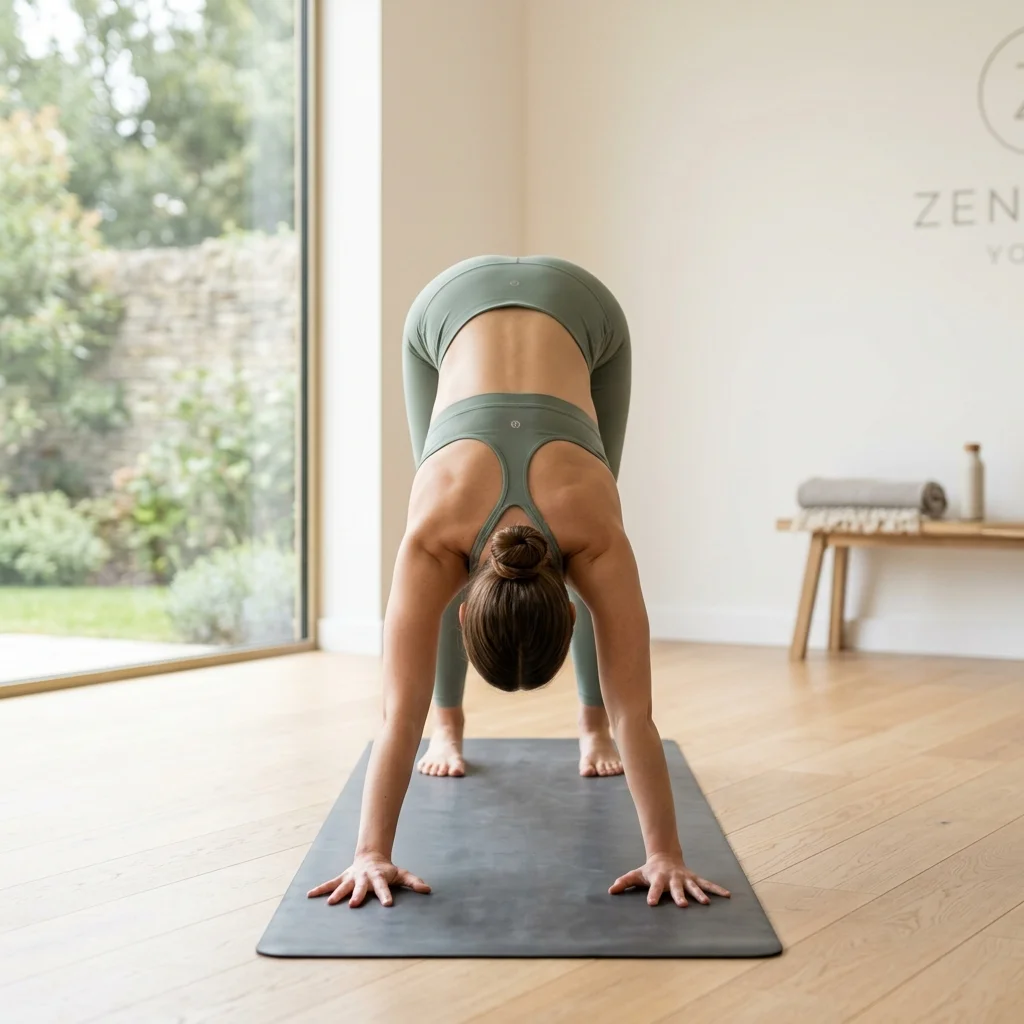
Just like building a skyscraper, an arm balance requires an impeccable base of support. Begin in a low squat (Malasana] and place your palms perfectly flat on your mat, shoulder-width apart, fingers spread exceptionally wide. Your index fingers should point straight forward or slightly outward to protect your wrists.
Key Details & Technique
- Actively grip: the floor with your finger pads—a technique known as "hasta bandha" or hand lock.
- This active: clawing distributes your body weight across your knuckles and activates your forearm flexors, providing essential dynamic braking power as you tip forward.
- For foundational: wrist training, explore our High Plank breakdown.
Pro Tip:
"Place a plush yoga block or folded pillow on the mat directly in front of your face. Knowing you have a soft crash pad waiting completely eliminates the subconscious fear of falling forward."
2 The Shelf: Securing Your Knees to Your Triceps
Lift your hips high toward the ceiling while keeping your knees deeply bent. Rise up onto the extreme tips of your toes and wedge your inner knees as high up onto your outer triceps or directly into your armpits as humanly possible. The higher up your arms your knees land, the more structurally secure your perch becomes.
Key Details & Technique
- Actively squeeze: your inner thighs toward one another, clamping your knees firmly against your arms.
- This adductor: engagement locks your legs into place and connects your lower body directly to your deep core stabilizers.
- Discover adductor: strengthening in our Yoga Poses Library.
3 The Physics of Flight: Shifting Your Center of Gravity
Here is the exact secret where most practitioners fail: Crow Pose is not a jump; it is a slow, deliberate tipping forward of your center of gravity. Keep your gaze (drishti] fixed on the floor about 12 inches in front of your fingertips. If you look back at your toes, your heavy head will pull your center of gravity backward, making flight entirely impossible.
Key Details & Technique
- Slowly shift: your body weight forward onto your hands until your elbows bend to about 90 degrees.
- As your: shoulders move past your wrist creases, your feet will naturally become weightless on the mat.
- Build essential: balance mechanics in our 3-week Core Strength Program.
Pro Tip:
"Do not attempt to lift both feet off the mat simultaneously at first. Shift forward and lift just your right foot, pressing your heel to your glute; hold for three breaths, lower down, then test your left foot."
4 Deep Core Hollowing: The Key to Weightlessness
Once your toes float off the mat, the real muscular work of Bakasana begins. Actively dome your upper back toward the ceiling by pressing the floor away through your protracted shoulder blades. Concurrently, hollow out your deep lower belly by pulling your navel firmly toward your spine.
Key Details & Technique
- Squeeze your: heels tightly up toward your glutes and point your toes.
- This deep: core compaction gathers your physical mass into a compact, buoyant ball, making you feel entirely weightless on your hands.
- For structured: core development, join our 30-Day Beginner Yoga Challenge.
5 Troubleshooting Common Obstacles and Bruised Arms
It is incredibly common to experience slight bruising or tenderness on your upper arms during your first few weeks practicing Crow due to the direct pressure of your kneecaps. As your core and adductor strength increases, you will lift your body weight upward rather than resting heavily downward into your skin.
Key Details & Technique
- Remember to: treat your balance journey with boundless playfulness and patience.
- For step-by-step: guidance across 150+ Yoga Poses, explore our comprehensive Yoga Poses Library.
Pro Tip:
"If your feet refuse to lift off the mat, stand on two yoga blocks before entering the pose. Elevating your feet gives you an immediate gravitational advantage when tipping forward onto your triceps."
✨ Summary & Next Steps
Taking flight in Crow Pose is an unforgettable milestone that transforms how you perceive your physical capabilities, balance, and inner courage. By establishing an active hand foundation, securing a solid knee-to-tricep shelf, shifting your visual gaze forward, hollowing out your deep core, and treating the exploration with joyful playfulness, you unlock the magic of effortless levitation. Place a pillow on your mat tomorrow and test out the one-foot lifting drill. Ready to build the core stability needed for advanced arm balances? Join our dynamic Core Strength Yoga Program today!
Frequently Asked Questions
Elena Rostova
Elena Rostova is an accredited yoga educator and anatomy specialist with over 15 years of clinical experience. She focuses on functional biomechanics and injury prevention, translating complex anatomy into accessible guidance for safe, sustainable practice.